


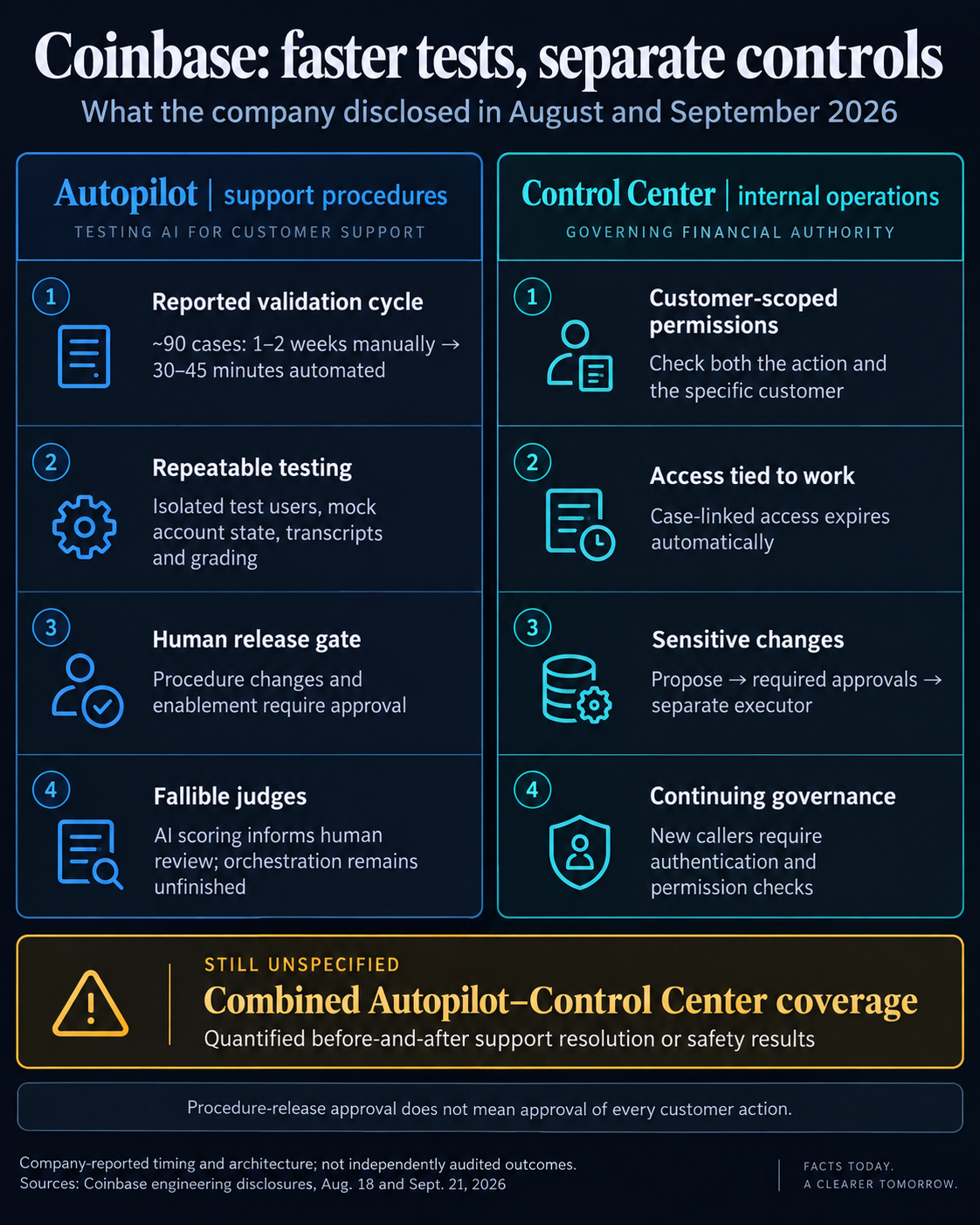
Coinbase says it can now complete a support-testing cycle of roughly 90 cases in 30–45 minutes, work that previously took one to two weeks of manual setup and execution. The figure, disclosed by its engineers on Sept. 21, gives Coinbase CEO Brian Armstrong’s push for an AI-native company a concrete example of automation reducing repetitive work.
The system, called Autopilot, tests the procedures that support bots follow when handling customer problems. It also retains human approval before procedure changes reach production. The next test for Armstrong’s operating model is whether faster procedure development produces reliable support and accountable actions on customer accounts.
Customers need their account problems resolved correctly and their data accessed only with proper authority. Coinbase’s disclosures describe work to address both needs, while leaving the effect on customers unmeasured. Approving changes, restricting permissions and measuring real results remain operating responsibilities as the company automates more work.
Where the time saving comes from
Armstrong announced an approximately 14% workforce reduction in his May 5 memo, citing both a weak crypto market and AI changing how employees work. He proposed fewer management layers, leaders who also contribute directly, smaller AI-native teams and experiments with one-person teams.
The September engineering account moves that operating argument into a specific support process. Coinbase says its bots look up account state, take bounded actions and escalate problems requiring greater judgment to a person. Autopilot helps maintain the procedures those bots follow.
Its testing service creates isolated test users and mock account states, simulates conversations, records transcripts and tool results, and grades what happened against expected behavior. Agents can help generate tests; a repeatable runner executes them. Coinbase says it shipped a hybrid system combining the service, GitHub Actions release gates and a user interface that engineering and non-engineering teams can use.
That division explains why the time comparison is useful. Repeatedly setting up test accounts, driving conversations and collecting results is work a shared service can perform consistently. Faster validation could make it practical to check procedure changes more often, provided the cases and expected outcomes remain appropriate.
The reported comparison measures the validation cycle, leaving customer response times and staffing savings outside its scope. Connecting that cycle to the workforce reduction would require evidence of which tasks were displaced and the resulting costs.
A shorter testing cycle gives Coinbase more capacity to evaluate changes. Whether that capacity produces better support depends on what the tests cover, what reviewers do with their findings and how the resulting procedures perform after deployment.
Autopilot uses adversarial conversations as well as tests of expected behavior. Coinbase says an AI model scores those conversations, but acknowledges that the judge can be wrong. Scores feed human review and release gates rather than independently deciding that a procedure is ready.
The release boundary separates a proposed procedure from one that a support bot can use with customers. Agents can suggest changes, while a person must approve production writes and enablement.
That is a safeguard against an automated quality loop promoting its own work without review. It also means review remains an operating responsibility as the system accelerates.
The approval scope should be read precisely. Coinbase’s statement concerns changes to the support procedures and their enablement. It does not say a human approves every action a deployed bot takes on an individual customer’s account.
Further automation remains unfinished. Coinbase says discovery, authoring, testing and analysis exist, while orchestration from an identified performance gap to a promoted procedure is still being developed. A fully shared contract for conversation summaries also remains unfinished.
That leaves integration work alongside the automation gain. A system that identifies a weak flow, generates a revision and tests it still needs reliable information passed between those steps and an accountable decision about release.
Permission to act is a separate control
Coinbase’s Aug. 18 internal-operations disclosure addresses another part of customer protection: who can access customer data and who can change it.
The company describes Control Center as a separate shared platform for support, compliance, legal, risk and engineering. Coinbase has not specified its coverage of Autopilot. Within the platform, authorization, audit records, approvals and rate limits sit in front of the underlying services.
Its permission checks consider both the requested action and the particular customer. Missing customer context on a customer-scoped operation means denial. Access is tied to assigned cases, limited to the customers involved and set to expire.
For designated sensitive changes, including refunds, account-state changes and limit overrides, the platform separates proposing a change from executing it. The proposal enters review, the required approvals must arrive, and a separate executor then performs the change. Failures are reserved for human handling.
Those controls answer questions that conversational testing cannot answer on its own. A procedure can describe the expected response, while an authorization system determines whether the caller may reach the relevant customer data. Approval rules determine whether a sensitive change can proceed.
Control Center also makes the continuing work explicit. Coinbase says new client types, including automated agents, must be brought under the authorization, audit and rate-limiting rules, with authentication boundaries revalidated as callers change.
Establishing how these controls apply to support automation would require a clearer account of which bots and actions pass through the permission and approval checks. The relevant coverage measure is the set of customer operations governed by those rules.
For the AI-native operating model, the consequence is straightforward: adding automated callers still requires someone to maintain the rules governing their authority. The architecture can make that work more consistent. Its effectiveness still depends on keeping each new caller within the rules.
Case-linked access provides a concrete example: permissions must continue to match the assigned work as cases and callers change. The account boundary needs to hold alongside faster procedure development.
More testing needs an outcome measure
The same need to connect activity to outcomes extends to Coinbase’s separate Continuous Adversarial Testing (CAT) security platform. On Sept. 15, Coinbase reported more than 150,000 scans of its production estate since mid-2026, including over 128,000 pull-request reviews, and more penetration-test findings being fixed. Those reported activities and fixes provide security context.
The distinction between testing and deployed performance is also central to the National Institute of Standards and Technology’s (NIST) July 2024 generative-AI risk profile. The voluntary framework recommends evaluating systems in real-world scenarios because controlled testing may miss problems and discusses measurement gaps between laboratory and deployment conditions. The framework offers a general standard for evaluating these claims.
Autopilot already points toward customer measures. Coinbase says customer-intent labels, resolution and customer-satisfaction signals help identify weak high-volume support flows. That suggests the company recognizes that completing tests and solving customer problems are different measures.
Yet the September disclosure does not publish quantified before-and-after customer-resolution or safety results. The useful next evidence would connect the deployed procedures to those outcomes, alongside the share of relevant support activity covered by the testing and permission systems.
Resolution quality would help show whether automation solves the customer’s problem. Escalation performance would help show whether cases requiring human judgment reach it. Evidence about unauthorized actions and errors would address protection more directly than the time required to run a test suite.
The reported 30–45-minute validation cycle is a concrete example of work being automated. The disclosed approval gates and access restrictions make accountability part of the operating model. Demonstrating the value to customers requires connecting both to results in live support, while carrying the review and governance work that the disclosed systems still require.
