


Bitcoin (BTC) continued its volatile trajectory today, slipping 0.70% over the past 24 hours. The asset’s slump has raised concerns among traders.
However, some analysts argue that Bitcoin’s performance is a result of potential price manipulation, citing a recurring pattern of declines around the US market opening, as well as institutional involvement.
Sponsored
Internal Manipulation vs. Market Dynamics: Decoding Bitcoin’s Decline
Bitcoin has defied all bullish expectations in Q4, a period that has historically been strong for the asset. While the October 10 market crash was a major factor behind BTC’s downturn at the start of the quarter, market watchers are now questioning the persistence of this weakness.
Traders have become increasingly frustrated by Bitcoin’s lack of response to market developments. For example, yesterday, Strategy (formerly MicroStrategy) announced it had acquired 10,624 BTC for $962.7 million.
Yet despite this bullish news, Bitcoin is once again in the red today, down 0.70% and trading at $90,487.
On the flip side, negative developments also trigger the same sell pattern. Analyst Ash Crypto highlighted that the market continues to behave irrationally and is not responding to positive developments as it typically would.
Sponsored
In a separate post, Ash suggested that Bitcoin’s crash from $126,000 to $80,000 cannot be dismissed as a normal market correction. He pointed out that since the October market crash and historic liquidation:
- US equities have risen 8%, with many stocks hitting new record highs.
- Bitcoin, however, remains 29% below its pre-crash level, and any short-term rallies have been met with heavy selling.
- Roughly $500 million in liquidations occur nearly every other day, suggesting persistent forced selling.
“If it was just a leverage it should have been a very short term and the market should have bounced pretty fast but instead we kept dumping without any major bounce. This is not normal. This looks like a few big institutions are playing with the market and liquidating both longs and shorts. Another rumor in town is that many big funds blew up on October 10th and they are selling BTC to cover their losses,” he added.
Furthermore, another analyst pointed to Bitcoin’s weekend price action as evidence of the latest manipulation. The post revealed that the cryptocurrency briefly fell from around $89,700 to $87,700, triggering about $171 million in long liquidations.
Within hours, the move sharply reversed, with Bitcoin surging to around $91,200 and wiping out an additional $75 million in short positions.
Sponsored
“This is another example of manipulation on the low-liquidity weekend to wipe out both leveraged longs and shorts,” Bull Theory wrote.
Is Jane Street Behind Bitcoin’s Morning Dumps?
Interestingly, the market watcher also noted a clear trend: Bitcoin often experiences sharp declines around 10 a.m., after the US market opens. This pattern has been visible since early November and mirrors similar activity observed earlier in the year.
The consistency suggests a coordinated approach, rather than a random response. Bull Theory points to Jane Street, a major high-frequency trading firm, as a possible source. Jane Street reportedly holds $2.5 billion of BlackRock’s IBIT ETF, making it its fifth-largest position.
Sponsored
“When you look at the chart, the pattern is too consistent to ignore: a clean wipeout within an hour of the market opening followed by slow recovery. That’s classic high-frequency execution. This means most of the dump in BTC isn’t due to macro weakness but due to manipulation by one major entity,” the analysis revealed.
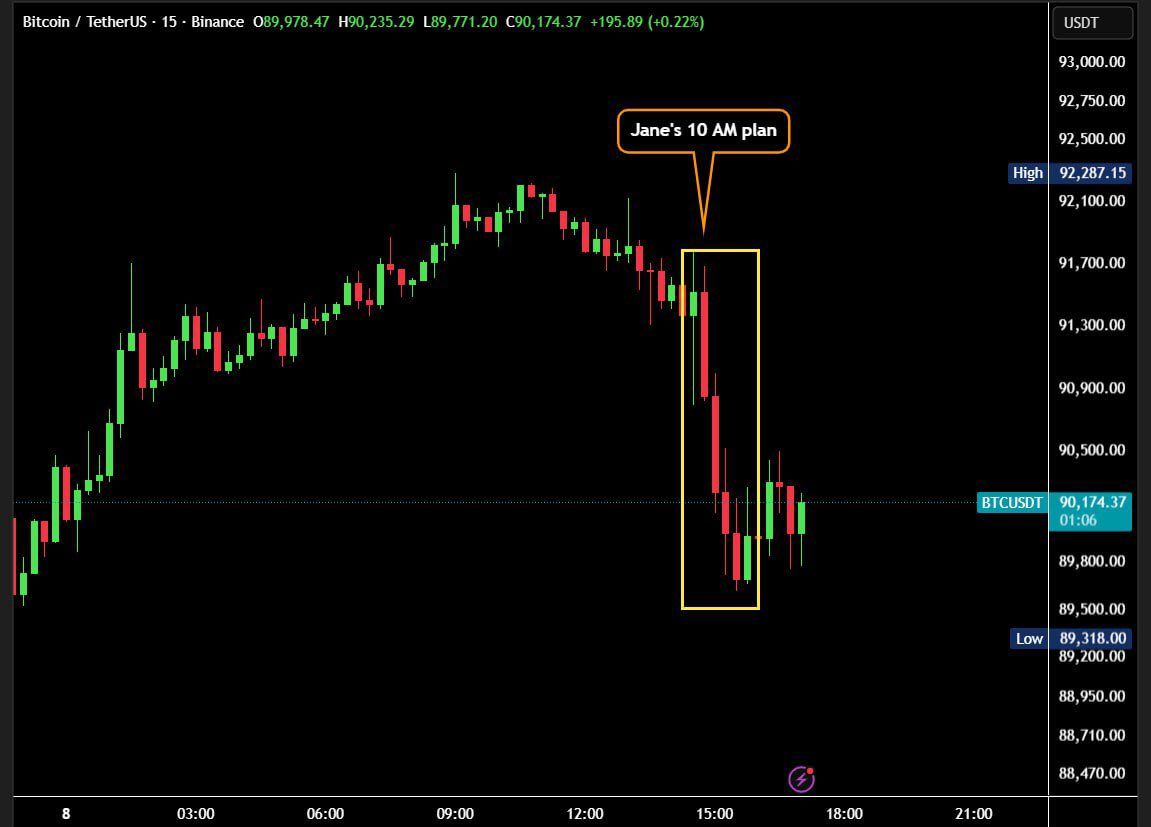
The suspected strategy is simple. High-frequency traders dump BTC at market open, push the price into liquidity pockets, then buy back at lower levels. They repeat this cycle, benefiting from predictable volatility and accumulating billions in Bitcoin.
“Yes thats called wash trading and has been illegal on the Stock Market since 1933. No laws on crypto they can wash trade all they like till they pass Market Structure Bill. The problem with tracking Jane Street is they dont do it onchain they do it through ETFs. We cant track their moves. Wintermute uses onchain with Binance but Jane Street is totally opaque,” Marty Party stated.
Even so, analysts believe the impact may be temporary. Once major operators complete their accumulation phase, Bitcoin could resume an upward trajectory driven by fundamentals.
